Artificial Intelligence in Colombia's
Judiciary
A judge, a generative AI tool, and a Constitutional Court ruling that changed things
Ruling T-323/2024, Constitutional Court of Colombia
Agreement PCSJA24-12243, Superior Council of Judicature (Dec. 2024)
"AI Experiences in the Judiciary" Survey, Executive Report (Jan.
2025), Dialogue between the Judiciary and the Ombudsman's Office (May
2025)

Three things worth knowing before the case
Understanding this changes how you read everything else
The tutela
Colombia's 1991 Constitution gave every citizen a direct way to go to court and defend a fundamental right. The first two courts ruled within weeks. The Constitutional Court then selected the case for what's called "revisión": a process where it picks cases of national importance to set rules that bind every judge in the country. If you're European, think of Germany's Verfassungsbeschwerde or Spain's recurso de amparo. The tutela works in a similar spirit, though it tends to be faster and more accessible at the first levels.
The Constitutional Court
Colombia's Constitutional Court is the final guardian of the rights written into the 1991 Constitution. By default, its tutela rulings only affect the people directly involved in that specific case. But when an issue goes beyond one dispute, the Court can extend its decision to all similar situations. European constitutional courts like Germany's Federal Constitutional Court or Spain's Tribunal Constitucional tend to reach that same outcome more directly, with rulings that bind everyone from the start. Colombia's model is more selective, but when it expands, the reach is just as broad.
Why this ruling matters beyond Latin America
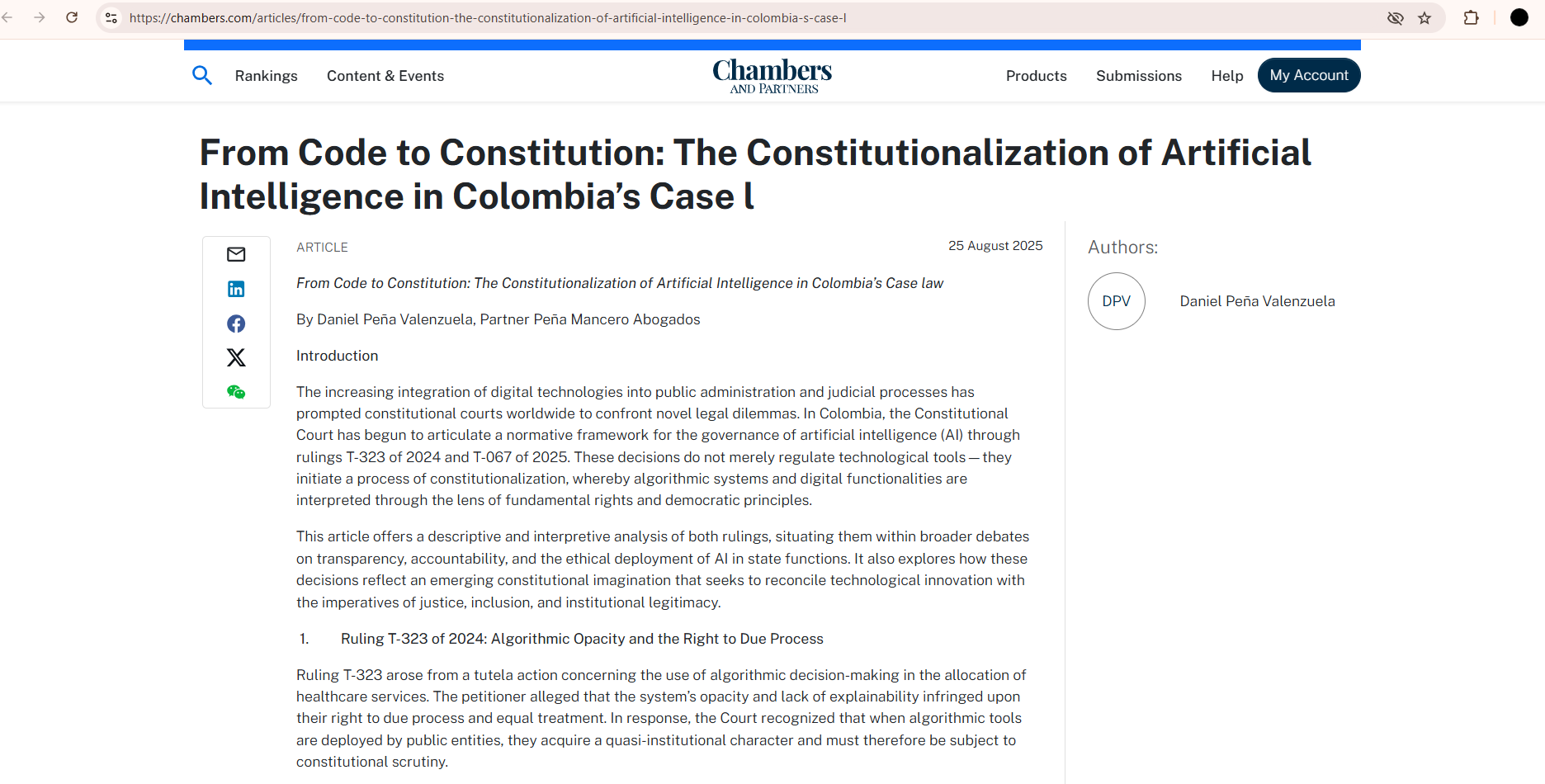
When this case arrived, Colombia had no AI law on the books. The Constitutional Court went back to basics: constitutional rights. In doing so, it drew on frameworks already developed by bodies like the Council of Europe's CEPEJ, which had published ethics guidelines specifically for AI in courts back in 2018. Five months before this ruling, the EU finalized its AI Act, which classifies AI tools used in judicial proceedings as high risk. Colombia arrived at the same conclusion, but through case law rather than legislation. That's what makes this ruling worth paying attention to beyond Latin America.
It started with a mom and her son.
"Blanca" and "Emilio" are fictional names. Per Agreement 02 of 2015 and Internal Circular 10/2022, the Court publishes two versions of every ruling involving minors: one with real names sent only to the parties, and one with fictional names for public distribution. This is the public version.
The trial court granted everything. EPS, Colombia's mandatory health insurer, ordered to eliminate copayments and cover transport.
The appellate court confirmed, but the judge also opened ChatGPT 3.5, a generative AI tool, to "extend the arguments."
ChatGPT's answers went straight into the official court record, word for word.
The judge had already decided before consulting ChatGPT. It was used to write, not to think.
The Court's Take
Ruling T-323/2024, Constitutional Court. Justice Juan Carlos Cortés González
Due Process: NOT violated
The judge had already made up his mind before opening ChatGPT. It wrote; it didn't think. That order of events was exactly what saved him.
Transparency: NOT met
Just saying "I used a generative AI tool" isn't enough. The parties have a right to know: which tool, what it was asked, what it can and can't do, what data went into it, why the judge was qualified to use it, and why it was necessary for this case at all. All of that has to go on the record, in plain terms.
Accountability: AT RISK
The reasoning belongs to the judge. Everything an AI tool generates has to be verified before it goes near a decision: accurate, legally sound, actually relevant. Knowing what came out isn't enough. The Court expects judges to understand how the AI tool works, not just what it produces. The ruling calls out black box systems specifically: you can see what you asked, you can see what came back, but nothing in between. Those cannot be used. When something is off, it goes on the record.
What the Court Actually Ordered
Five binding orders in Ruling T-323/2024
1. Emilio's transportation coverage
The EPS must cover trips to every specialist visit and diagnostic procedure, not just therapy. For as long as the family can't pay for it themselves.
2. No more copayments, and no more runaround
Under Colombian law, children with disabilities from families in extreme poverty are fully exempt from copayments. It's a protection that mirrors what exists across most EU states. The EPS was required to apply this automatically. The family shouldn't have had to go to court for it.
3. A message to every judge in Colombia
Not a ban. An exhortation: if you use ChatGPT or any similar AI tool, ask yourself whether it makes sense for the case and whether it holds up against constitutional principles and judicial independence. The Court laid out 12 specific principles to guide that judgment.
4. Guidelines within four months
The Superior Council of Judicature had to produce a guide for the use of these tools in the judiciary. The ruling specifically called out ChatGPT by name. They delivered: Agreement PCSJA24-12243, December 2024.
5. Train every judge, starting now
The Judicial School must send this ruling to every judge in the country and put together ongoing training on the use of these tools, grounded in rights, not just technology.
The 12 Principles
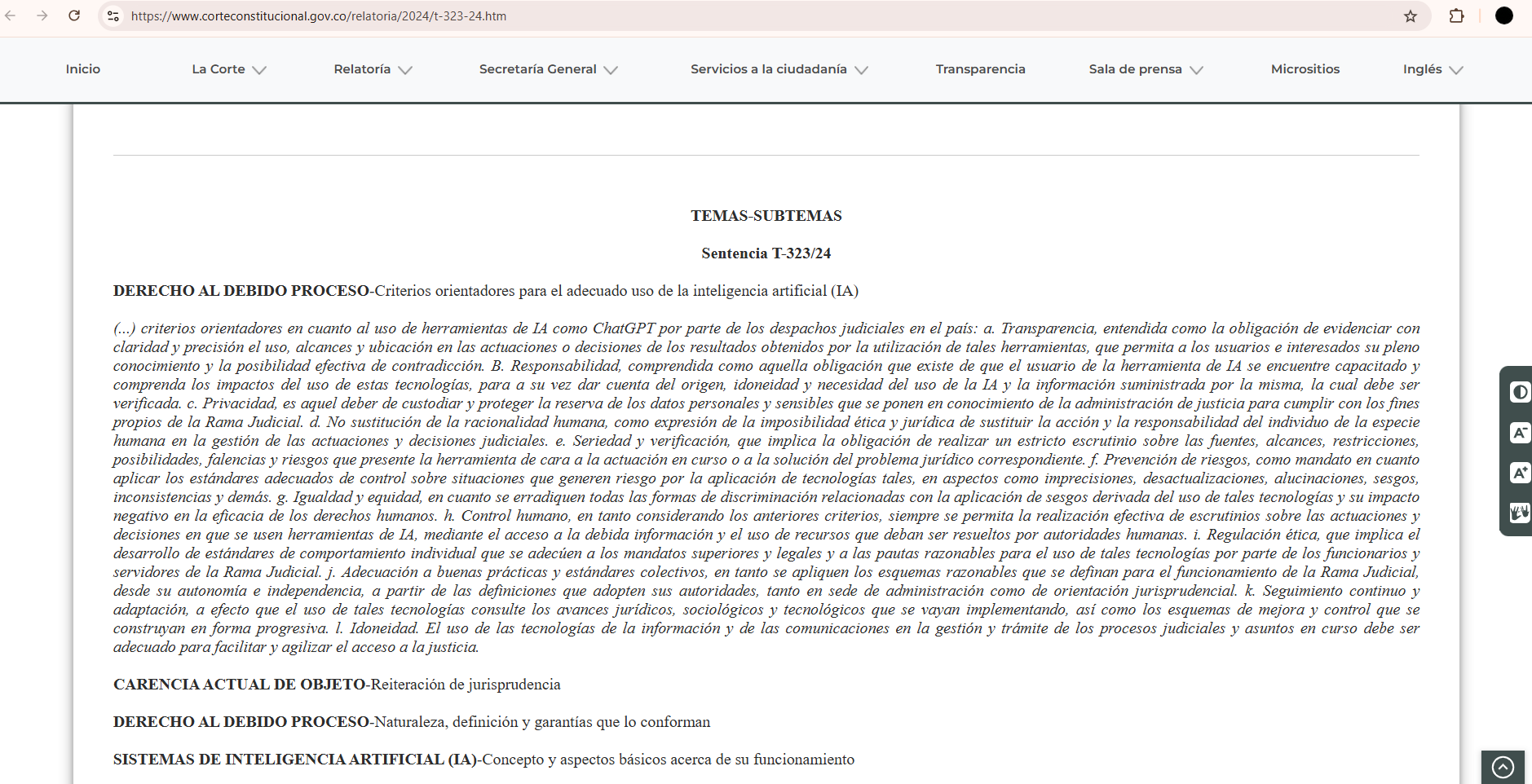
The Court didn't just point out what went wrong. It set out 12 principles that any use of AI tools in judicial work has to respect, and ordered the judiciary to build everything else on top of them.
These aren't suggestions. The Agreement PCSJA24-12243 is directly grounded in all twelve.
Source: Ruling T-323/2024, Constitutional Court of Colombia
Principles
T-323/2024
What the Agreement Had to Cover
The Court didn't just set principles. It told the Superior Council of Judicature exactly what the guidelines needed to address.
Keep the reasoning human
Weighing evidence, writing the reasoning behind decisions, interpreting facts: those stay with the judge. Any use of an AI tool that substitutes for that is a due process violation.
Apply safeguards even to routine tasks
Document management, text editing, administrative work: permitted. But data protection and impartiality safeguards apply even in those uses.
Make transparency, accountability and privacy non-negotiable
Transparency, accountability, and privacy are not optional add-ons. They apply to every use of AI tools across the judiciary.
Name someone responsible
There must be an identifiable person who can answer questions about any decision where an AI tool was used, and review what it actually did.
Write in plain language
Whatever an AI tool generates and ends up in a judicial process has to be understandable to the people affected by that process.
Regulate yourself
Judges and court staff must apply their own ethical controls every time they use an AI tool. No external system replaces that.
Put rights before technology
Whatever guidelines the Superior Council of Judicature adopts, the digitalization of justice has to stay within a framework that protects fundamental rights, especially due process.
Coordinate across institutions
The judiciary has to coordinate with Congress, the national government, international bodies, and AI tool providers to define what the courts specifically need.
Track usage and publish the findings
A monitoring system for AI tool use in court proceedings has to be put in place, with findings published as part of the judiciary's accountability obligations.
Train everyone, from day one
The Judicial School must build training on AI tools into all judicial education, covering all roles and backgrounds within the judiciary, and include it in the entrance exam for new judges.
How We Got Here
From one court record with ChatGPT in it to a full regulatory framework, in under two years
Ruling T-323/2024, Constitutional Court
The first ruling on the use of generative AI tools in Colombian justice history. It also told the Superior Council of Judicature to come up with concrete guidelines, and gave them four months to do it.
📄 Ruling T-323/2024Agreement PCSJA24-12243, Superior Council of Judicature
They delivered. 16 articles covering what's allowed, what isn't, who's responsible, and how to report usage. Three categories of permitted use, clearly defined.
📄 Agreement PCSJA24-12243 (EN)Survey: "How Judges Are Using These Tools"
3,152 judiciary staff answered questions about how they're actually using AI tools. The results, including an interactive dashboard, were made public.
📄 Executive Report 📊 Interactive DashboardJudiciary + Ombudsman's Office
Both institutions started working groups together to review how the Agreement is being implemented, with a focus on human rights.
📄 Workshop ReportThe Numbers
Survey conducted July 11–26, 2024 (before the August ruling) · 3,152 respondents · 8.2% of total judiciary staff · national coverage
judiciary staff
already use AI tools
of those using them
work in courts
of
judges
use them
of
magistrates
use them
ChatGPT is the most widely used tool in the judiciary.
free accounts
judiciary-provided
licenses
paid personal
subscriptions
tech partnerships
& collaborations
Bogotá accounts for 18.7% of all reported users · Executive Report, January 2025
The Official 7-Step Checklist
Superior Council of Judicature's guide to using AI tools without getting into trouble · 📄 Manual
Why are you using it?
Have a clear purpose before you open any AI tool
Is it actually allowed?
Check Agreement PCSJA24-12243 before you start
Know your AI tool
Understand its limits and how it handles the data you put into it
Remember the basics
Free public chatbots and confidential case information don't mix. Note which AI tool you used, keep personal data out of it, and the decision stays yours.
You still have to check
Verify every piece of information the AI tool generates before it goes anywhere
Put it on the record
The AI tool name, model, provider, date, and the exact prompts used all go in the official case record.
Report it
Send usage info to the
Digital Transformation and IT Unit (UTDI):
inteligenciartificial@
deaj.ramajudicial.gov.co
Still a Work in Progress 🔭
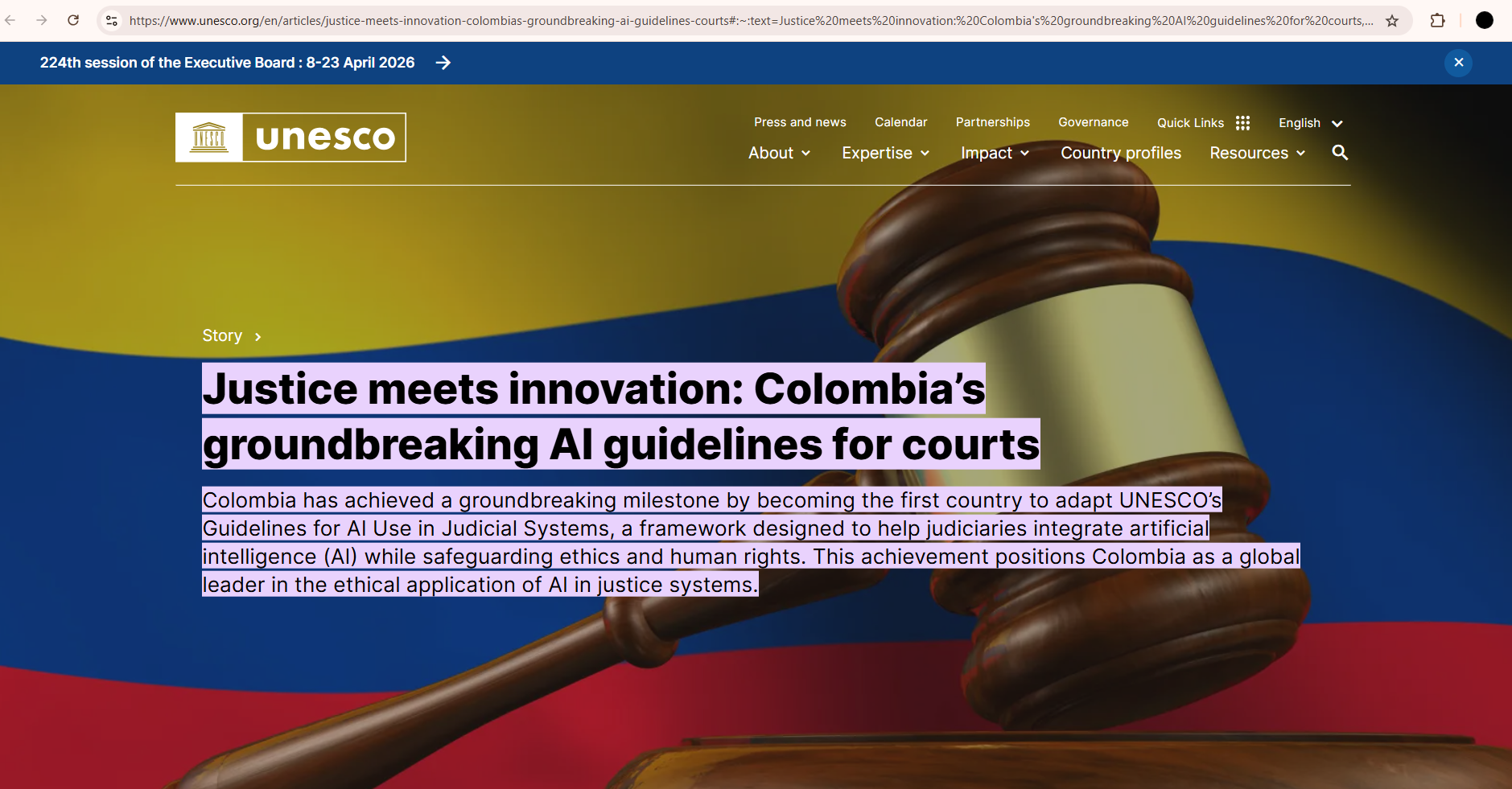
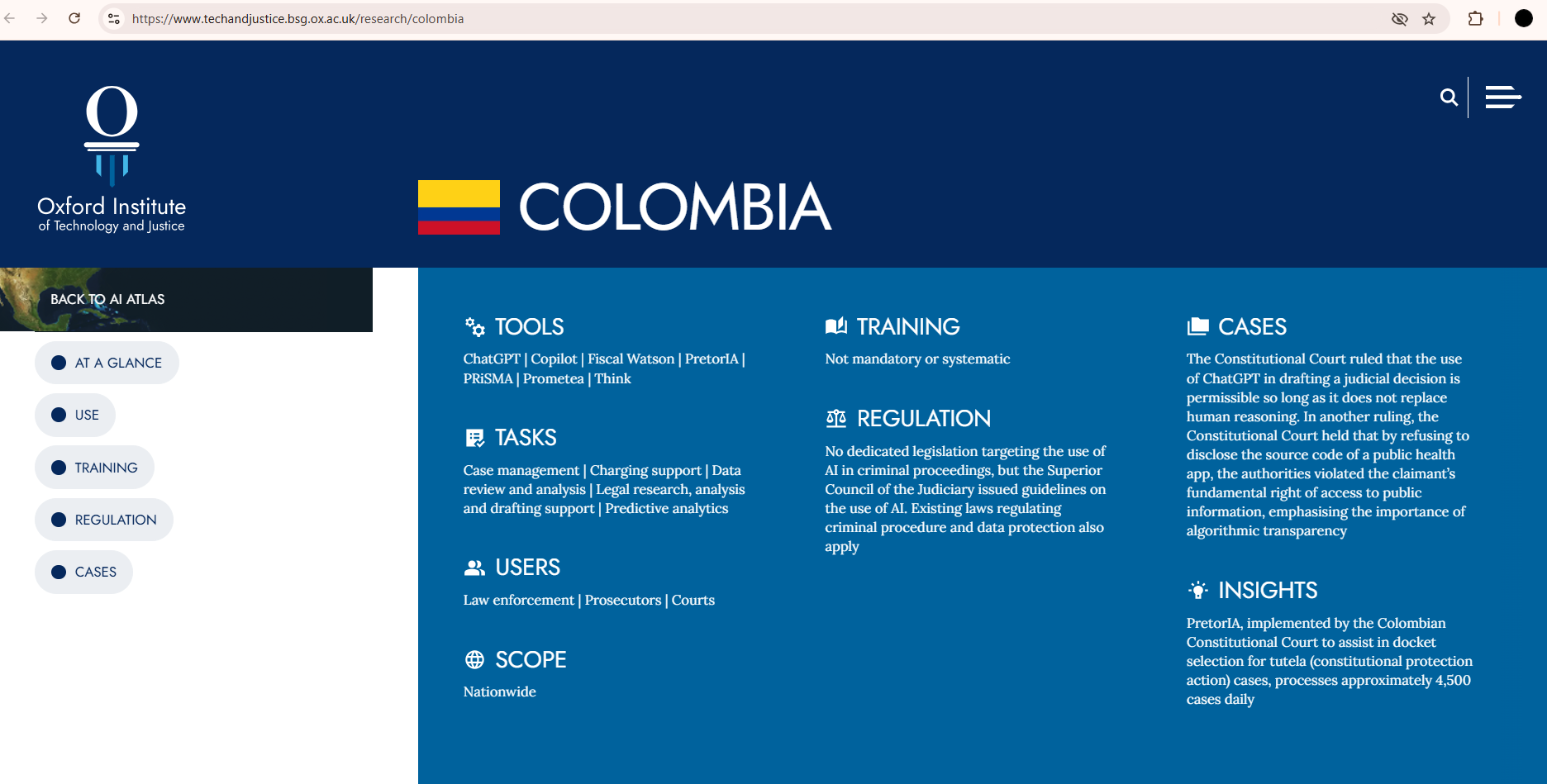
No other country in Latin America has done this
Colombia is the first in the region to have a regulatory framework specifically for how courts use AI tools. The framework itself treats the rules as a starting point, not a final answer.
Nobody's doing this alone
The Judiciary, the Ombudsman's Office, and the Judicial School are working together on implementation. The Agreement also calls for collaboration with UNESCO and other international bodies.
Where they want to end up
A dedicated platform built for Colombian law. Not a generic tool retrofitted for court use. Fewer fabricated answers, less built-in bias, and no privacy gaps.